










News & Insights
How Taxwell is using AI to transform the tax filing experience
16 July 2026
For most people, filing taxes is a once-a-year obligation that demands time and effort. Taxwell CEO Dermot Halpin talks with Cinven Partner Stuart Walker about how the business is using AI to change that – the products, the operations, and the discipline that makes it work.
Customer first approach
Stuart Walker: How would you describe Taxwell’s overall AI strategy? How is it structured and where does it create value?
Dermot Halpin: Our strategy is centred on the customer. Our goal is simple: make a complex, often time-consuming tax filing process feel fast and intuitive, requiring less manual effort and easier review from the user. AI helps us achieve our goal by helping to reduce friction, guiding users through the journey, and delivering measurable improvements to the tax filing experience.
Beyond the product, AI is embedded in how we run the business, including how we build software and maintain our tax engine. We’ve invested heavily in infrastructure to make that possible. We have a dedicated AI engineering team and platform with shared services in production and a multi-provider architecture. This allows us to experiment and ship new products and features rapidly. This is a core engineering capability we have built from the ground up.
Products or features that would have historically taken months to build are now delivered in a fraction of that time.
Dermot Halpin, CEO, Taxwell
Product innovation in action
Stuart Walker: Can you share examples of where Taxwell has used AI to improve the tax filing experience for both its consumer and tax professional customers?
Dermot Halpin: We’re using AI effectively across both. Let me give you a few examples of recent innovations implemented for our consumers and small business customers at TaxAct.
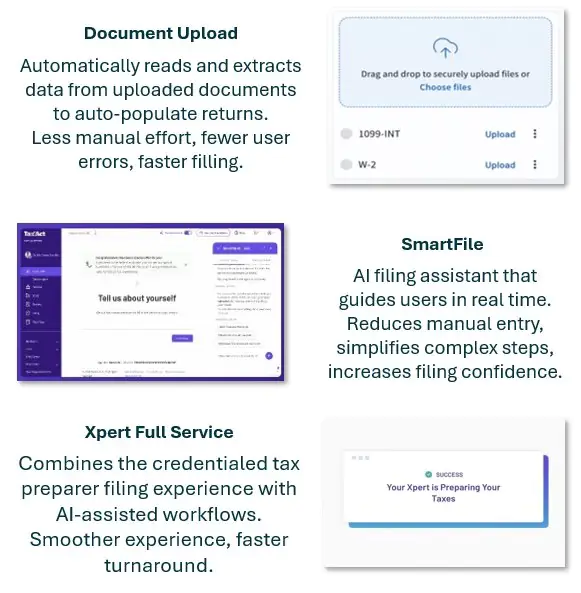
Document upload is probably the simplest to explain. You drop in your tax documents, and the product automatically reads them, pulls out relevant data, and fills in tax forms for you. This solves a specific customer pain point and is a clear example of AI minimising manual effort.
That foundation powers our SmartFile and Xpert Full Service products, which go further. SmartFile is an AI assistant built directly into the TaxAct journey that guides you step-by-step through your return – not just answering questions but processing uploaded documents and proactively making suggestions based on your specific tax situation and where you are in the filing journey.
Within Xpert Full Service – where a credentialed tax preparer completes and files your return for you – AI handles much of the upfront heavy lifting. It builds personalised document checklists, tracks and manages what has been uploaded, and pre-populates forms for the tax preparer to review.
And then there’s our Claude connector. The idea is simple – meet customers where they are. Increasingly, people are starting their tax questions in AI assistants, so we’ve made TaxAct’s knowledge base natively accessible inside Claude. Customers can get tax estimates, look up deadlines, understand their documents, and more.
The same logic applies to our professional customers. We’re rolling out similar AI capabilities on Drake, our professional tax software. The centrepiece is a purpose-built AI assistant that understands how preparers work: they’re typically inside a client’s return, so the AI adapts to that context. It can read the return, answer preparer-specific questions, and help process client documents, all without the preparer leaving their workflow. We’re using AI to reduce administrative burden so preparers can focus on work that genuinely requires their expertise and offer their clients a better experience in the process.
Shift to AI-enabled operations
Stuart Walker: How are you using AI more broadly across operations, and what impact is this having on internal teams and customers?
Dermot Halpin: We’ve been embedding AI across the whole business since 2023, and I would say most notably in customer service and software development.
SmartFile is itself a customer service innovation – resolving questions in real-time within the filing flow and handling queries that would previously have generated a phone call or support ticket. Beyond that, AI runs across all our support channels – offering 24/7 coverage, faster resolution times, and higher customer satisfaction – while allowing agents to focus on cases that benefit from personal attention.
In software development, AI is embedded across the different stages of the engineering lifecycle. Our engineering team uses AI coding tools extensively, and we’re shifting towards agent-style assistance with our engineering team responsible for directing, reviewing, and signing off work at every stage. This has been made possible through the platform we’ve built: shared services, access to best-in-class tools and models, and strong working practices. The impact shows up most clearly in greenfield projects, where AI can be most readily applied. Products or features that would have historically taken months to build are now delivered in a fraction of that time.
AI is also helping accelerate our tax engine update cycle – a complex, expert-led process that requires deep knowledge of tax law and form definitions. We’re on a clear path toward a more efficient annual update cycle, giving our tax developers better tools so they can focus on the interpretive, high-judgement work that really requires their expertise.
Measurable value creation
Stuart Walker: How do you prioritise where to apply AI? How do you separate initiatives that are likely to deliver real impact from those that likely won’t?
Dermot Halpin: In technology businesses there has always been more to do than there have been resources available to do it. Even if AI has allowed everyone to move faster and get more done, prioritisation is still critical. What hasn’t been changed by AI is that we always ground ourselves on the user need: how is this initiative solving a real problem? That keeps us focused on areas where AI can reduce friction, simplify the experience, or improve outcomes. We don’t apply AI for its own sake. Every initiative solves a very real problem and does so in a way that protects our customers’ trust and data.
Every initiative is also tied to clearly defined success metrics from the outset – whether that’s completion rate, NPS, cost-to-serve, session depth – alongside the privacy and compliance standards that apply to anything touching our customer data. We take a test-and-learn approach within this framework: deploy quickly, measure performance, recalibrate where needed, and scale only what works and meets our standards.
Take SmartFile, for example. Within three weeks, we had various iterations of SmartFile and data showing which version was driving the deepest engagement. That, combined with our usual privacy and data protection checks, gave us the confidence to move forward with the best version. That is not months of planning followed by a single launch. It’s rapid experimentation generating real signal, within a process built to protect the customer at every step.
Ultimately, we are a highly KPI and outcome-focused business that prioritises the customer, and that discipline applies equally to AI initiatives.
We don’t apply AI for its own sake. Every initiative solves a very real problem and does so in a way that protects our customers’ trust and data
Dermot Halpin, CEO, Taxwell
Stuart Walker: Finally, what does success look like for Taxwell in the years ahead?
Dermot Halpin: Ultimately, it comes back to the customer. Success for us is a filing experience that feels effortless. One that understands your situation, anticipates what you need, and moves you through the process quickly and with confidence. Our interaction with and use of AI capabilities will continue to help us deliver on that ambition.
Related news and insights